
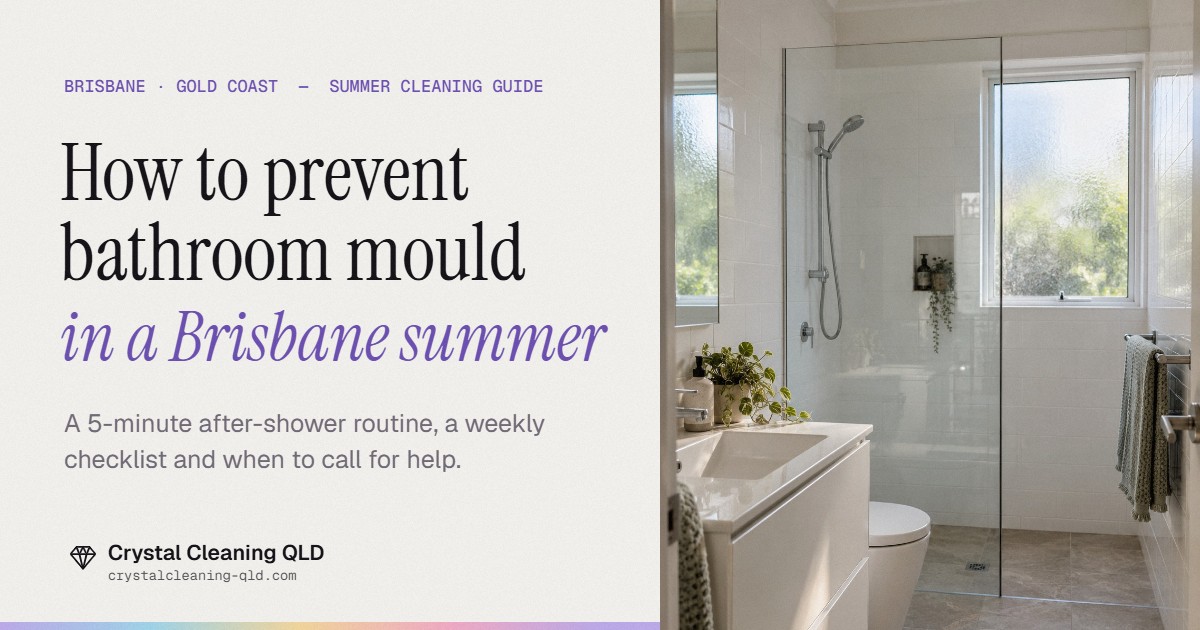
To prevent bathroom mould in a Brisbane summer, keep the room dry and moving air. Run the exhaust fan or open a window during and after every shower, squeegee the screen and tiles, hang towels and bath mats to dry, and give wet areas a proper clean each week. Small spots can be cleaned safely at home; mould that is widespread, keeps returning or comes from a leak needs a different fix.
Key takeaways
- Mould grows in damp, dull and poorly ventilated spaces. Bathrooms tick all three boxes in summer.
- A five-minute routine after each shower does more than an occasional big scrub.
- Clean the places moisture sits: grout lines, silicone, the shower screen track, the exhaust fan cover and under bottles.
- Never mix cleaning products, and never dry-brush mould.
- If mould covers a large area, keeps coming back or is caused by a leak, report it or call a specialist rather than repeatedly cleaning it.
Why bathroom mould spreads faster in a Brisbane summer
South-east Queensland summers are warm and humid, and storm season brings plenty of wet days. That makes it harder for steam from a hot shower to clear, so water sits on tiles, grout and silicone for longer.
The Queensland Government’s mould guidance explains that mould grows in damp, dull and poorly ventilated spaces such as kitchens, bathrooms and laundries, and that dust and dirt also help mould grow. In other words, prevention is mostly about two things: drying the room quickly and not giving mould anything to feed on.
The same guidance notes mould can affect health, especially for people with asthma or allergies, a weakened immune system, older people and people who are pregnant. If anyone in your home falls into those groups, it is worth being consistent with the steps below.
The 5-minute after-shower routine
This is the habit that makes the biggest difference. It takes about five minutes and needs only a squeegee and a dry microfibre cloth.
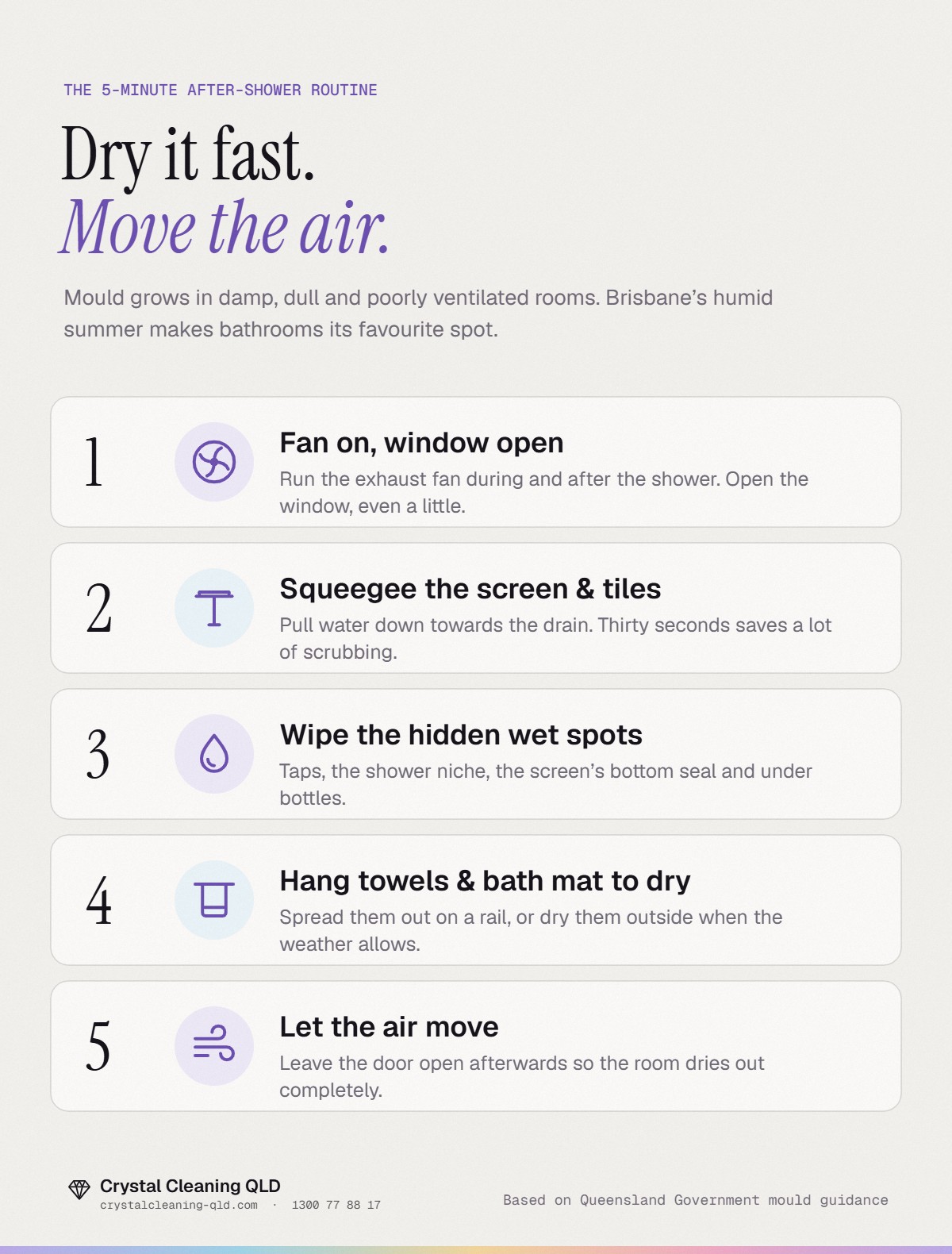
- Fan on, window open. Turn the exhaust fan on before you start the shower and leave it running for a while afterwards. If you have a window, open it, even a little.
- Squeegee the screen and tiles. Pull water down the glass and the wall tiles towards the drain. Thirty seconds here saves a lot of scrubbing later.
- Wipe the hidden wet spots. Run a dry cloth around the taps, the shower shelf or niche, the bottom of the screen and the base of shampoo bottles.
- Hang towels and the bath mat to dry. Spread them out on a rail, or dry them outside when the weather allows. A damp bath mat left on the floor keeps the room humid.
- Let the air move. Leave the bathroom door open once you are finished so the room can dry out completely.
A tip from Japanese homes
Many Japanese households finish a bath by rinsing the walls and floor with cool water, then wiping them down and running the bathroom fan. Cool water brings the warm, steamy room temperature down faster, which makes conditions less comfortable for mould, and it rinses off soap residue that mould would otherwise feed on. It is a simple habit that suits Brisbane’s humid months well.
Your weekly bathroom checklist for mould prevention
Once a week, give the wet areas a proper clean. Focus on the places where water and soap residue collect.
| Area | What to do | Why it matters |
|---|---|---|
| Grout lines | Scrub with a soft brush and a suitable bathroom cleaner, then rinse and dry | Porous grout holds moisture and soap scum |
| Silicone seals | Wipe along the shower base, bath edge and basin, then dry | Mould often starts in the corners where silicone meets tiles |
| Shower screen and track | Clean the glass, the bottom seal and the track | Water pools in the track and rarely dries |
| Exhaust fan cover | Turn the fan off at the switch and dust the cover | A dusty cover moves less air, and dust feeds mould |
| Shelves and bottles | Lift everything, wipe the shelf and the base of each bottle | Bottles trap water underneath |
| Shower curtain and bath mat | Wash and dry completely | Fabric stays damp for a long time |
| Window frame and sill | Wipe away condensation and dust | Window corners stay wet after showers |
If you want to go further, the Queensland Government also suggests cleaning up leaks and spills straight away, leaving space between furniture and walls so air can flow, and keeping dehumidifier trays clean.
How to clean small spots of mould safely
For small patches on hard surfaces such as tiles or a shower base, follow these steps, based on the Queensland Government’s guidance for removing small areas of mould:
- Protect yourself. Wear gloves and a disposable P1 or P2 respirator, available from hardware stores. Open the window and run the fan.
- Keep others out. Ask other people to stay out of the room while you work, and lay a drop sheet or old towel on the floor.
- Use two buckets. One for your cleaning solution and one for clean rinse water.
- Wipe, don’t brush. Wipe the mould with a microfibre cloth and the solution. Rinse the cloth in the clean water, not the solution. Do not dry-brush mould, because that spreads spores.
- Rinse and dry. Wipe the area with a fresh damp cloth, then dry it with another clean cloth.
- Throw the cloths away. Using fresh cloths for each step helps stop the mould spreading and coming back.
For the cleaning solution, the Queensland Government lists options including three parts vinegar to two parts water, a 70% methylated spirits and 30% water mix, tea tree oil and water, or a commercial mould remover used exactly as the label directs.
Safety first: never mix cleaning products. Bleach combined with vinegar, ammonia or other acidic cleaners can release toxic gas. Use one product at a time, rinse well and keep the room ventilated.
When mould isn’t a cleaning job
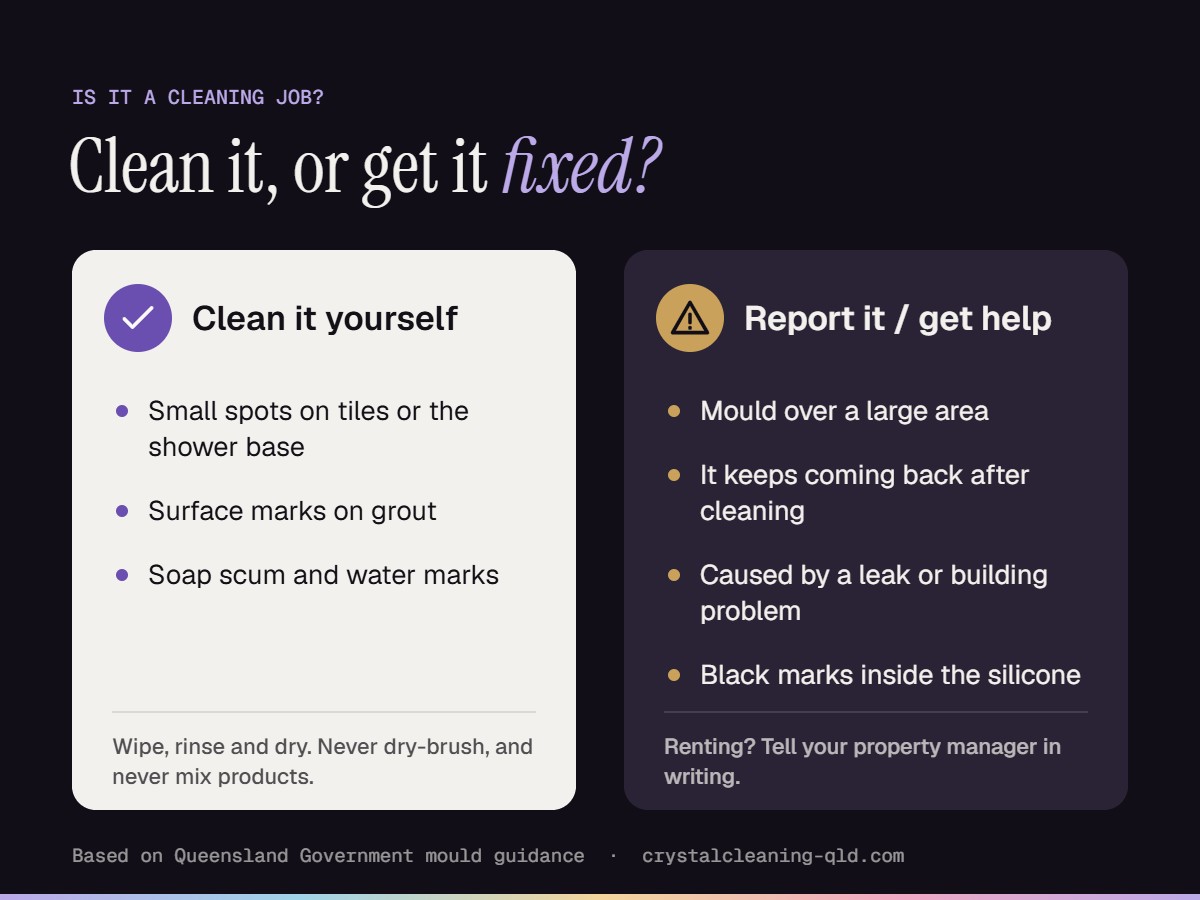
Cleaning removes surface mould, but it cannot fix the cause. Stop and get the right help when:
- The mould covers a large area of wall or ceiling.
- It keeps coming back shortly after cleaning.
- It is caused by a leak or building problem, such as a dripping tap, a failed shower seal or a fan that is not vented properly.
- The mould is underneath the silicone. Black marks inside the sealant usually cannot be cleaned out, and the silicone may need replacing by a qualified tradesperson.
- Someone in the home is unwell. If you are worried about the health effects of mould, speak with your GP.
Renting? Tell your property manager or owner about mould as soon as possible, and put it in writing. Under Queensland’s minimum housing standards, a rental must be free from mould when you move in and throughout the tenancy, unless the tenant caused it. Who cleans and pays depends on the cause, so check the Residential Tenancies Authority’s mould guide.
Extra care for older people, NDIS participants and people with asthma
Scrubbing grout and reaching into the corners of a shower involves bending, stretching and standing on a wet floor. For many people, that is exactly the kind of task that is safer to hand over.
If you are an NDIS participant, talk with your support coordinator or plan manager about whether household tasks are included in your plan. Veterans can ask about DVA house cleaning support. You can also tell your cleaner exactly what matters most, such as the shower recess and grout, using a simple cleaning brief.
How Crystal Cleaning QLD can help
Our regular house cleans include the bathroom wet areas where mould starts: the bath, shower, screen and recess are cleaned and sanitised, toilets scrubbed, sinks and taps polished, mirrors cleaned and floors mopped and sanitised. We bring our own equipment and supplies, there is no lock-in contract, and you don’t need to be home for the visit.
A regular clean keeps surface mould and soap scum under control. It is not a substitute for fixing leaks or for specialist mould remediation, and we will tell you honestly if what we see needs a plumber, your property manager or a specialist.
We clean homes across Brisbane’s northern suburbs, including Ashgrove, Stafford, Kedron, Clayfield, Wilston and Everton Park, and on the Gold Coast, including Robina, Varsity Lakes, Burleigh Heads, Palm Beach and Ashmore. Learn more about general house cleaning, NDIS house cleaning or compare regular vs deep cleaning.
Want help keeping your bathroom fresh this summer? Request a quote or call 1300 77 88 17. We aim to send quotes within one business day.
Frequently asked questions
Does vinegar kill bathroom mould?
The Queensland Government lists a solution of three parts vinegar to two parts water as one option for cleaning small areas of mould on hard surfaces. Wipe, rinse and dry the area afterwards, and never mix vinegar with bleach.
How often should I clean my bathroom in summer?
Do the five-minute dry-down after every shower and a thorough clean of the wet areas once a week. Bathrooms that get heavy use, or that have no window, may need extra attention.
Why does mould keep coming back in my shower?
Usually because the room is not drying out, or because the mould is inside the grout or silicone rather than on top of it. Improve ventilation first. If it returns quickly after cleaning, look for a leak or failed seal.
Is a dehumidifier worth it in Brisbane?
It can help in a bathroom or laundry with poor airflow, especially during long humid spells. Empty and clean the water tray often. Moisture-absorbing products from the supermarket are a low-cost option for small spaces and wardrobes.
Can Crystal Cleaning QLD remove mould?
We clean surface mould and soap scum on bathroom surfaces as part of our cleans. For large areas, mould that keeps returning or mould caused by a leak, we will recommend you contact your property manager, a plumber or a mould specialist.
Sources: Queensland Government, Mould and damp (last reviewed 18 June 2026); Residential Tenancies Authority, Mould.
This article is general cleaning information, not medical or building advice. If you have health concerns about mould, speak with your GP.